When the Lights Go Out: What Protecting Your Family Really Means
Yes, you're a capable, strong parent. You handle schedules, solve problems, and keep everything moving. But when the lights go out, the equation changes fast. Refrigerators warm up, phones lose signal, kids get anxious, and small decisions suddenly carry weight.
Protecting your family in that moment isn't about toughness. It's about preparation, calm thinking, and having systems you can rely on without hesitation. The parents who handle blackouts well aren't the ones who panic-Google solutions on a dying phone. They're the ones who already have answers at hand.
The Reality Parents Face in a Blackout
For families with kids, power outages aren't just inconvenient. They disrupt the routines that keep everyone stable. Bedtimes fall apart. Meals become uncertain. The house gets quiet in an unfamiliar way, and children pick up on a parent's uncertainty faster than most adults realize.
The cascade of decisions starts immediately, and each one matters more than it would on a normal day:
Food Safety: The 4-Hour Clock
Your refrigerator keeps food safe for about 4 hours unopened. A full freezer holds temperature for 48 hours, a half-full one for 24. But how do you actually know when to toss the chicken versus the condiments? Which items survive, which become dangerous, and what can you pivot to? An offline AI trained on food safety protocols gives you specific, real-time answers: "The ground beef has been above 40°F for 3 hours. Discard it. The hard cheese is fine. Here's a shelf-stable meal plan for the next 48 hours using what you have."
Electrical Safety: What Not to Touch
Most parents know where the breaker box is. Fewer know how to safely reset a tripped breaker, when NOT to reset one (a burning smell means stop), how to manage extension cord loads without overheating, or how to properly connect a portable generator without backfeeding the grid. These aren't edge cases. They're the exact mistakes that cause house fires and electrocutions during outages every year. A Survival Expert system walks you through each step with the specific ratings of your equipment in mind.
Water: The Silent Urgency
Extended outages often knock out water treatment plants or reduce water pressure. Suddenly you need to know: Can you drink the tap water? How do you purify it if not? How much does your family of four actually need per day (answer: roughly one gallon per person)? Can you filter creek water with what's in your garage? A survival LLM with 1,097 indexed manuals can tell you exactly how to build a gravity filter, which purification tablets to use for what volume, and how to safely store water for multi-day outages.
Temperature Control: Heat and Cold Kill Quietly
In summer, a house without AC reaches dangerous interior temperatures within hours, especially for infants, elderly family members, and pets. In winter, pipes freeze, hypothermia sets in gradually, and carbon monoxide from improper indoor heating kills hundreds every year. An offline system helps you calculate safe room temperatures, identify which rooms to consolidate into, seal windows efficiently, and avoid the deadly mistakes people make with propane heaters, charcoal grills, and generators indoors.
Medical Situations: When 911 Can't Come Fast
During widespread outages, emergency services get overwhelmed. Response times stretch from minutes to hours. If your child has an asthma attack, someone falls down stairs in the dark, or a family member with diabetes needs guidance on insulin storage without refrigeration, you need answers now, not when a dispatcher becomes available. A Survival Expert system draws from military field medical manuals, Red Cross first aid protocols, and wilderness medicine guides to give you step-by-step triage instructions calibrated to your situation.
Communication: Staying Connected Without Cell Service
Cell towers have backup batteries that last 4 to 8 hours. After that, your phone becomes a flashlight. Do you know how to reach neighbors, family across town, or emergency services without cellular? An offline AI can walk you through setting up a handheld radio, identifying local emergency frequencies, using a car battery to charge devices, and even establishing a neighborhood communication plan before the next outage hits.
Beyond the First Night: When Hours Turn to Days
Most families can improvise through a few hours. The real test comes at 24, 48, and 72 hours. That's when stored food runs thin, device batteries die completely, morale drops, and the gap between "we're fine" and "we need help" narrows fast.
At 48 hours without power, a well-prepared family is cooking shelf-stable meals, keeping the house at a livable temperature, rationing water intelligently, and keeping kids occupied with a structured routine. An unprepared family is sitting in the dark, arguing about whether the milk is still safe, and driving around looking for an open gas station.
The difference isn't money or survival skills. It's having a system that tells you what to do next.
What a Survival Expert Kit Looks Like at 72 Hours
System assessment: check food temps, secure the house, set up emergency lighting, brief the family. AI provides a prioritized checklist based on your household size, season, and location.
Food triage and first meal plan. Water inventory. Device charging strategy using backup power. Kids' bedtime routine adapted for no-electricity conditions. AI helps you calculate exactly how long your Jackery/generator will last at current draw.
Shift to conservation mode. Identify what's safe in the fridge vs. what goes. Set up passive cooling or heating. Establish communication check-ins with neighbors. AI suggests which circuits to prioritize if partial power returns.
Transition to shelf-stable meals. Water purification if tap becomes unreliable. Morale management: structured activities, routines, normalcy. AI provides recipes from your available supplies and guides water treatment step by step.
Evaluate whether to stay or relocate. AI helps you assess road conditions, fuel range, shelter options, and what to pack for a family evacuation kit. If staying: advanced water strategies, neighborhood resource pooling, and longer-term food planning.
It's Not Just Blackouts
Power outages are the most common scenario, but a Survival Expert system covers the full spectrum of disruptions families face:
🌀 Severe Weather
Tornado shelter procedures, hurricane preparation timelines, flood evacuation routes, post-storm safety checks for gas leaks and structural damage
🔥 Wildfires
Air quality assessment, evacuation packing lists by family size, defensible space creation, smoke inhalation first aid, re-entry safety protocols
🏔️ Remote Travel
Vehicle breakdown procedures, backcountry navigation, altitude sickness recognition, wildlife encounter protocols, emergency shelter construction
🔒 Infrastructure Failures
Boil-water advisories, gas line safety, supply chain disruption meal planning, neighborhood mutual aid coordination, home security during civil unrest
🏕️ Camping & Outdoors
Safe campfire building, water source identification and purification, plant identification, knot tying for shelters, weather pattern reading, snake and insect bite treatment
🚗 Vehicle Emergencies
Roadside repair guidance, tire changes in unsafe conditions, overheating engine procedures, stranded-in-winter protocols, signaling for help on rural highways
Confidence Comes from Systems, Not Guesswork
The goal isn't to become an electrician, medic, or survivalist overnight. It's to build a simple, reliable setup you can execute under pressure, especially with children watching how you respond.
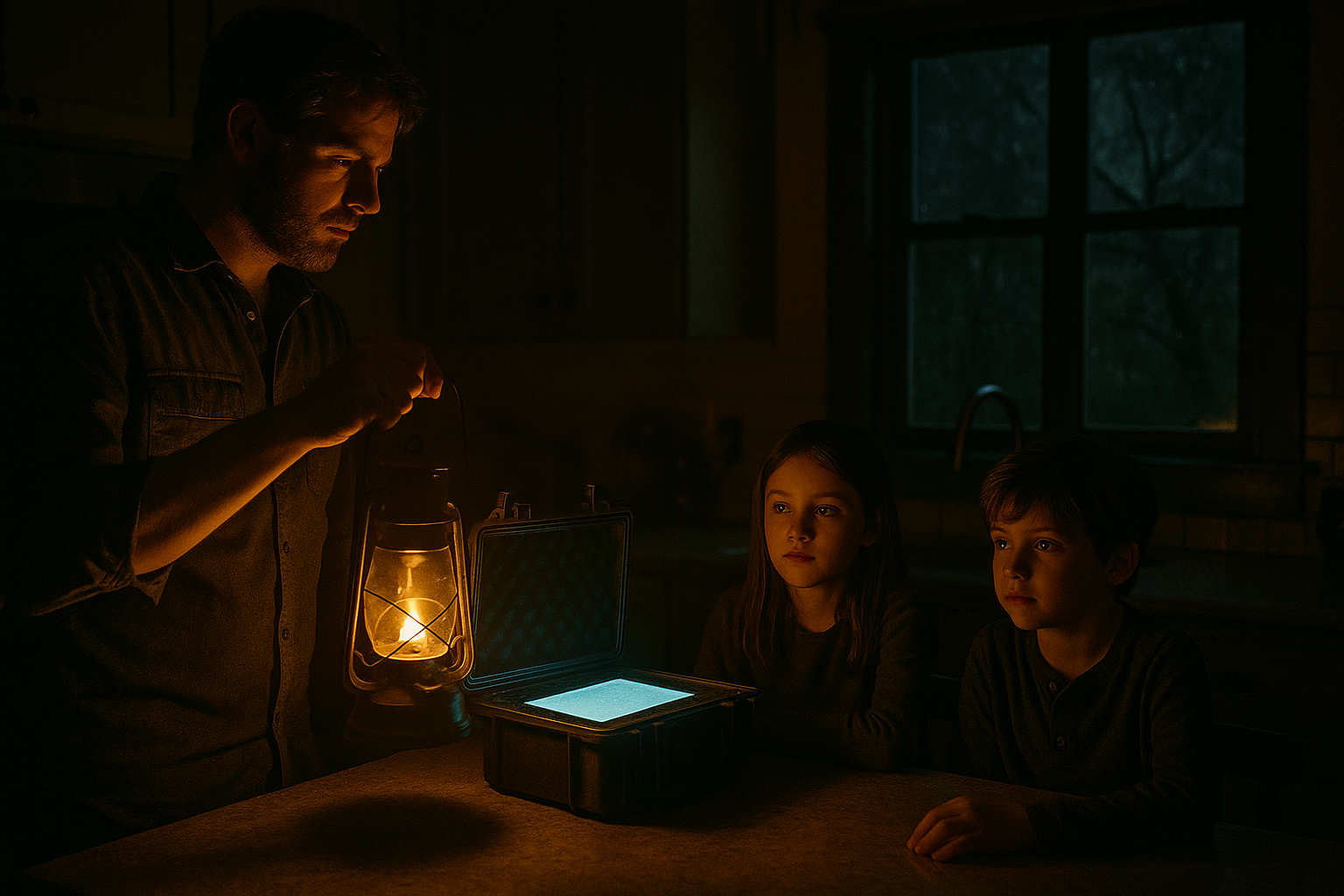
Kids don't need you to have every answer. They need to see you move with purpose. When a parent opens a case, pulls up a clear set of instructions, and starts working through a checklist, the entire household's stress level drops. That's leadership, and it's available to anyone who prepares.
A structured kit paired with clear guidance helps you move from reaction to leadership: keeping food safe, maintaining comfort, restoring normalcy faster, and showing your family that disruption doesn't mean disorder.
Why Parents Choose Survival Expert
- ✓ No internet required. Works when the grid, cell towers, and Wi-Fi are all down. The AI and all 1,097 manuals run entirely on the local device.
- ✓ Plain-language answers. Ask "how do I purify water for my kids" and get step-by-step instructions, not a 200-page PDF to scroll through.
- ✓ 8+ hours of battery life. The integrated Jackery power station runs the full system for over 8 hours and recharges via wall, car, or solar.
- ✓ Built for real scenarios. Not a novelty gadget. Covers medical triage, food safety, water purification, electrical safety, communications, navigation, and more.
- ✓ Ruggedized and portable. Pelican 1615 case handles drops, water, and extreme temperatures. Throw it in the truck, keep it in the garage, take it to the cabin.
The Bottom Line
Every parent knows that feeling: the power goes out, the house goes dark, and a small voice from the other room says, "Mom? Dad? What's happening?"
What you say next matters. But what you do next matters more. The parents who handle emergencies well don't have superpowers. They have preparation. They have a system. They have answers ready before the questions come.
That's what a Survival Expert kit gives you: not fear, but confidence. Not paranoia, but readiness. The ability to look your family in the eye during the worst moment and say, "We're going to be fine. Here's what we do."
Starting from $2,499 · Ships ready to deploy